A speeding ticket from three years ago, or a misdemeanor that was dismissed: will either one stop you from working as a signing agent? The answer depends on a points table most applicants never see. Below: how the screening most companies ask for works, from the SPW’s own published standard, and what to do if your report gets something wrong.
The answer first
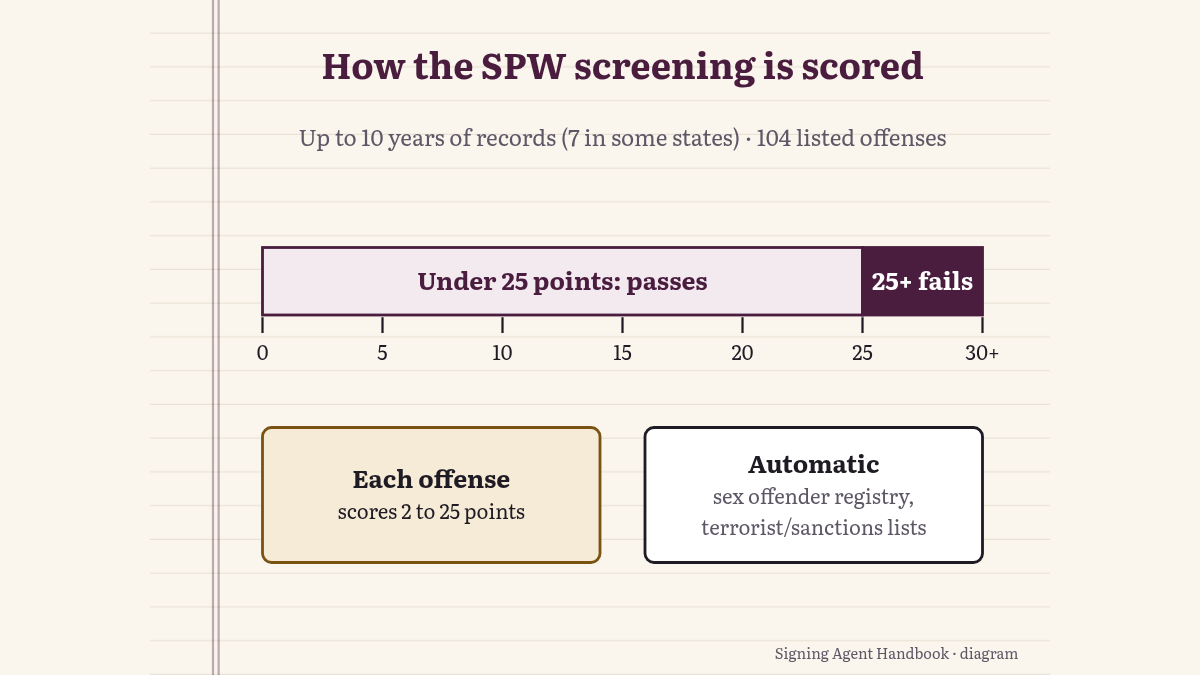
Most signing services and title companies ask signing agents to pass a yearly background screening built on the Signing Professionals Workgroup (SPW) standard. It covers up to 10 years of records (7 in some states) and scores 104 listed offenses from 2 to 25 points. A total of 25 or more fails. A match on the sex offender registry or the terrorist and sanctions lists disqualifies automatically. If your report is wrong, federal law gives you the right to dispute it with the screening company.
Disclosure: There are no affiliate links in this guide yet. If we add any later, we’ll say so right here. We aren’t paid to rank anything, and nothing here guarantees signing work or income. Our disclosure policy
Key facts
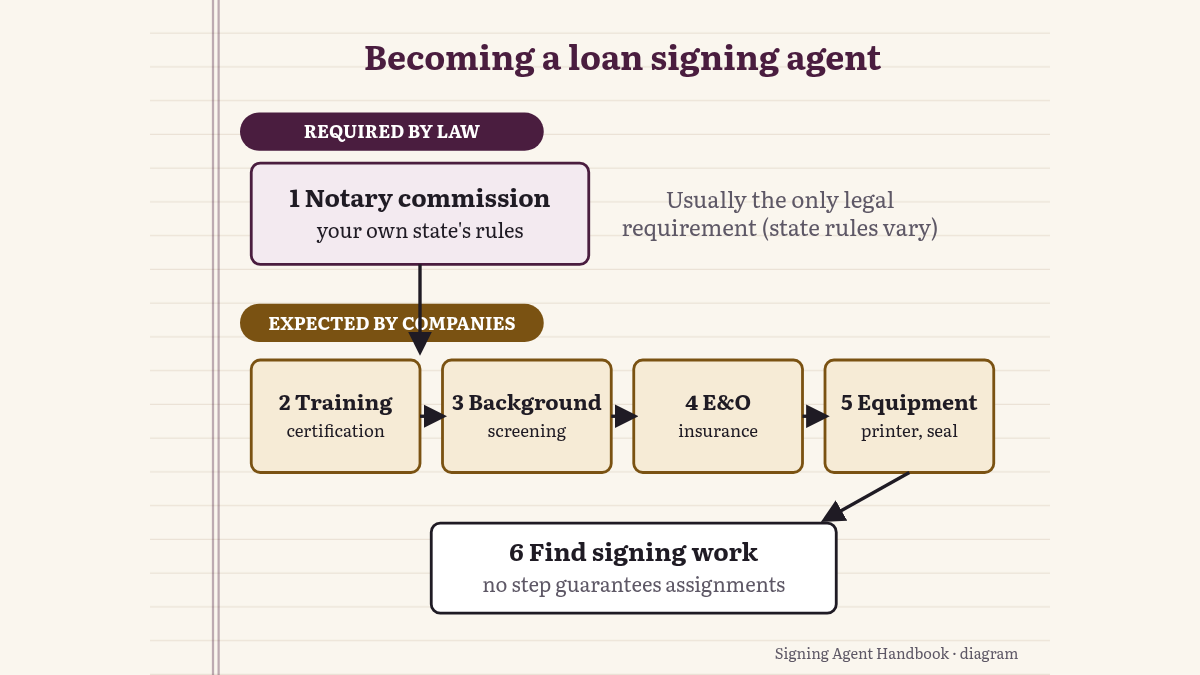
- Required by law: no federal or state law requires a signing agent screening. Some states screen notaries for the commission itself, which is a separate check.
- Expected by companies: an annual screening that meets the SPW standard, often bundled with a certification.
- Pass mark: 24 points or fewer passes; 25 or more fails (SPW).
- Look-back: 10 years; 7 in CA, CO, HI, KS, MD, MA, MI, MT, NH, NM, NY, TX and WA (SPW, 2026 update).
- Errors: dispute with the screening company. Federal law requires a free reinvestigation, generally within 30 days.
Why do signing agents need a background screening?
Signing agents handle borrowers’ personal and financial information, so lenders, title companies and signing services want them screened. The National Notary Association puts it this way: notaries seeking signing work “must meet stricter background screening requirements because they have possession of sensitive borrower information” (National Notary Association).
The SPW, an industry standards group, also lists background screening first in its Code of Conduct (SPW Code of Conduct, 2016).
Here’s the distinction: the NNA notes that 12 states require notaries to pass a background check for the commission. The signing-agent screening is a different, stricter, industry check that companies ask for on top of that.
What does the screening search?
Under the SPW standard, a compliant screening searches these sources (SPW Background Screening Standards):
| Search | How it’s used |
|---|---|
| Social Security number trace | Confirms identity and address history (where the court searches run) |
| County criminal court search | Scored by the points grid |
| Federal district court search | Scored by the points grid |
| Nationwide criminal database | Scored by the points grid |
| Motor vehicle records | Scored by the points grid |
| National sex offender registry | Automatic disqualification on a match |
| USA PATRIOT Act / terrorist watch and sanctions lists (UN, OFAC, Bank of England, DTC debarred parties, U.S. BIS lists, World Bank debarred firms) | Automatic disqualification on a match |
Identity is verified by Social Security number and driver’s license, and results follow your SSN, not your name, the NNA adds (National Notary Association).
How far back does it go?
Ten years of federal, state and county records. The SPW’s 2026 update notes that California, Colorado, Hawaii, Kansas, Maryland, Massachusetts, Michigan, Montana, New Hampshire, New Mexico, New York, Texas and Washington “limit reporting to 7 years.” Nevada moved from 7 years to 10 on June 10, 2015.
The clock may start later than you think. The NNA says records are reported “based on the last action taken on a case (e.g., end of probation or jail sentence) and not the date of the crime/infraction.”
How is it scored?
The SPW standard assigns “one hundred and four separate offenses … a point value of 2 to 25 points. A cumulative score equal to or greater than 25 produces a fail result.” The NNA puts it the other way round: “A total score of 24 points or below means you’ve passed.”
A few rows from the SPW’s 2026 scoring grid, to show the range (see the full standard for every offense):
| Offense (as SPW names it) | Points |
|---|---|
| Non-moving violation | 2 |
| Speeding 6 through 15 mph over | 3 |
| Speeding 16 through 25 mph over | 5 |
| Disorderly conduct (up to misdemeanor) | 5 |
| Reckless driving (up to misdemeanor) | 10 |
| Other misdemeanor convictions | 10 |
| DUI (up to misdemeanor) | 20 |
| Violation of notary duties | 25 |
| Other felony convictions | 25 |
Because points add up, several minor items can reach 25 together. Values are revised from time to time (the 2026 update raised some offenses compared with the 2024 version), so check the current grid rather than an old screenshot.
What about dismissed, pending or deferred cases?
According to the NNA’s summary of the standard:
- Dismissed, expunged or pardoned: not included. The reporting scope “includes both pending cases and convictions unless dismissed, expunged, or pardoned.”
- Pending cases: included.
- Deferred adjudication and pretrial diversion: “scored until all terms specified by the court are satisfied.” After that, they’re no longer reported.
If you aren’t sure how a specific record will be treated, ask the screening company before you pay, or speak with an attorney about your own record. We can’t tell you how your case will score.
How long does it take, and how often do you redo it?
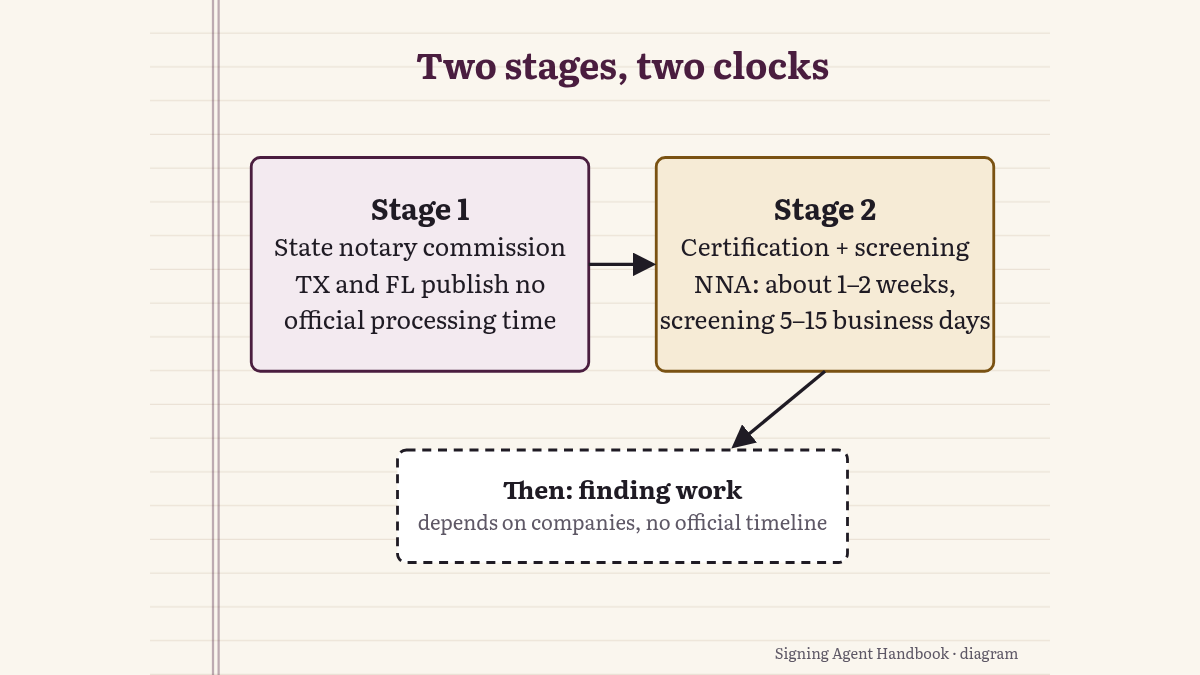
Results from the NNA’s vendor, Backgrounds Online, “typically take 5-15 business days” (National Notary Association). Under the industry standard the NNA cites, you renew the screening every year (National Notary Association). Many people get it through a certification package. See NNA signing agent certification.
Which screening do companies accept? It varies by company, so ask each one before you pay. In a November 2025 NotaryCafe thread, working signing agents said the NNA screening is the one most loan-signing clients accept, while some contract gigs ask for Sterling instead (NotaryCafe forum). Another thread notes Sterling was bought by First Advantage and, per the poster, no longer sells checks to individuals (NotaryCafe forum). These are forum posts, not official policy.
What if your report has a mistake?
Federal law gives you a dispute right. Under the Fair Credit Reporting Act, if you dispute the completeness or accuracy of information in your file, the consumer reporting agency must, “free of charge, conduct a reasonable reinvestigation,” generally within 30 days, which can be extended by up to 15 days in some cases (15 U.S.C. §1681i).
The FTC’s advice for background reports is to “contact the background reporting company to explain the mistakes and ask that they fix them,” include supporting documents, and then check the revised report. The FTC also asks people to tell it if they think a background check company included errors (FTC). That FTC page is written for job applicants. Signing agents usually work as independent contractors, so for questions about which notice rules apply to you, ask an attorney.
The CFPB’s consumer guide to background screening reports covers reviewing your report and disputing errors in writing (CFPB).
Common slip-ups
- Assuming a dismissed case counts against you. Under the standard as the NNA describes it, dismissed, expunged and pardoned cases aren’t included.
- Counting years from the offense date. Reporting runs from the last action on the case, such as the end of probation.
- Forgetting traffic records. Motor vehicle records are scored, and several small tickets add up.
- Letting the screening lapse. Companies expect a current one, renewed yearly.
- Not disputing errors. If something is wrong, dispute it with the screening company in writing and keep copies.
Screening questions, answered
What disqualifies you from being a loan signing agent?
Under the SPW standard: a cumulative score of 25 points or more, or any match on the national sex offender registry or the PATRIOT Act / terrorist and sanctions lists.
Does a misdemeanor disqualify you?
Not automatically. It depends on the offense’s points and your total. “Other misdemeanor convictions” score 10, while some specific misdemeanors score more (DUI up to misdemeanor scores 20). Check the full grid.
Do speeding tickets count?
Yes. Motor vehicle records are scored, from 2 points (non-moving violation, or 1-5 mph over) up to 15 (46+ mph over).
How long does the background check take?
Usually 5-15 business days, according to the NNA.
Is this the same as my state’s notary background check?
No. Some states check notaries for the commission. The signing-agent screening is a separate industry standard.
Where to go from here: Not commissioned yet? Start with how to become a loan signing agent. Comparing certifications that include a screening? See loan signing agent certification.
How this guide was researched
Our sources: the SPW’s published standard (2026 update), the National Notary Association’s screening guide, the U.S. Code and FTC/CFPB pages, all checked October 27, 2026. We quote a few rows of the SPW grid and link the full standard rather than reproducing it. We aren’t attorneys or screening companies, and this isn’t legal advice. We can’t predict how a particular record will score. Spotted a problem? Contact us.
Sources
- Signing Professionals Workgroup, Background Screening Standards (page and 2026 PDF): https://signingprofessionalsworkgroup.org/background-screening-standards/
- Signing Professionals Workgroup, Code of Conduct (2016): https://signingprofessionalsworkgroup.org/wp-content/uploads/2016/02/spw-code-of-conduct-2016.pdf
- National Notary Association, Background Screenings for Notary Signing Agents: https://www.nationalnotary.org/knowledge-center/signing-agent-resources/background-screenings
- National Notary Association, How to Become a Notary Signing Agent: https://www.nationalnotary.org/signing-agent/nsa
- National Notary Association, Notary Signing Agent Training (screening turnaround): https://www.nationalnotary.org/notary-signing-agent-training
- 15 U.S.C. §1681i (FCRA, procedure in case of disputed accuracy): https://www.govinfo.gov/content/pkg/USCODE-2023-title15/html/USCODE-2023-title15-chap41-subchapIII-sec1681i.htm
- NotaryCafe forum, “Which Provider Makes sense to Use for Background Checks” (Nov 2025): https://forum.notarycafe.com/t/which-provider-makes-sense-to-use-for-background-checks/54553
- NotaryCafe forum, “Getting a Background Check”: https://forum.notarycafe.com/t/getting-a-background-check/57766
- FTC, Employer Background Checks and Your Rights: https://consumer.ftc.gov/articles/employer-background-checks-and-your-rights
- CFPB, A Closer Look: Background screening reports: https://files.consumerfinance.gov/f/documents/cfpb_closer-look-background-screening_report.pdf
- About the National Notary Association: “The National Notary Association is the nation’s professional Notary organization and serves the professional, educational, career and business needs of Notaries throughout the U.S. Since 1957, the NNA has helped Notaries to serve society responsibly and ethically.” Linking policy: https://www.nationalnotary.org/support/linking-policy
General information, not legal advice.