The quick answer
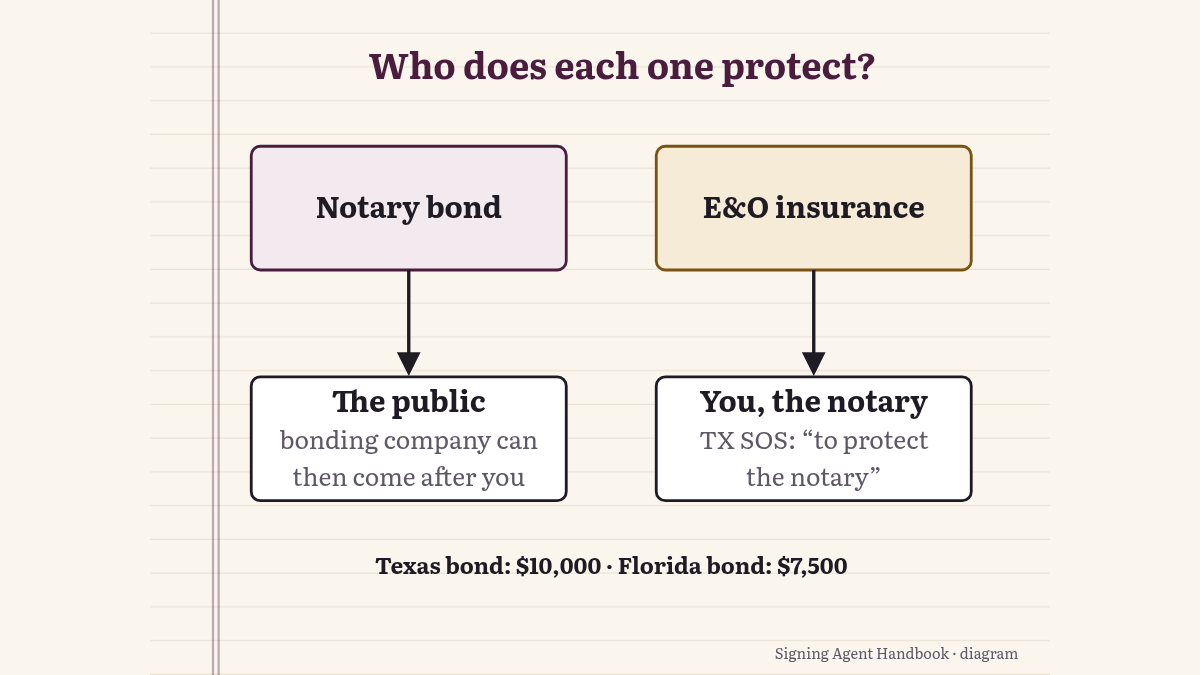
A notary bond protects the public. If your mistake harms someone, they can recover from the bond, and the bonding company can then come after you. E&O insurance protects you. The Texas Secretary of State puts it plainly: E&O policies “are additional insurance purchased by the notary to protect the notary, and not the public” (TX SOS FAQ). Many states require a bond. For traditional notaries, E&O is usually optional by law but commonly expected by signing companies.
Disclosure: There are no affiliate links in this guide, and there won’t be: earning referral fees on insurance or bonds requires a state insurance license, which we don’t hold. We aren’t paid to rank anything, and nothing here guarantees signing work or income. Our disclosure policy
Key facts
- Bond: required in many states. Texas $10,000, Florida $7,500 (statutes below)
- E&O: generally optional by law for traditional notaries (Florida requires it for online notaries), and often expected for loan signings
- E&O price example: NNA $25,000 / 4-year policy, $65 in Texas and in Florida (checked Oct 22, 2026)
- Check with your state if: you’re unsure whether your state requires a bond, or how much
A signing service asks for your “E&O certificate,” and you assume your bond covers it. It doesn’t. The confusion goes further than that. In September 2026 a Notary Cafe poster renewing a $1,000,000 policy noticed a SigningOrder notice saying notary E&O and signing-agent E&O aren’t the same coverage, and asked whether they needed “1 policy or 2” (thread). Below: who each one protects, the statute text from Texas and Florida, and real price examples.
What does a notary bond do?
A bond is a guarantee to the public that you’ll do the job properly. It doesn’t insure you.
- Texas: each notary must “execute a bond in the amount of $10,000 with a solvent surety company… payable to the governor, and conditioned on the faithful performance of the duties of office.” The bond “is not void on first recovery, and may be sued on in the name of the injured party” until the full amount is recovered (Tex. Gov’t Code §406.010).
- Florida: a notary must “give bond, payable to any individual harmed as a result of a breach of duty by the notary public acting in his or her official capacity, in the amount of $7,500” (Fla. Stat. §117.01(7)(a)).
Here’s the catch: if a claim is paid from your bond, the surety may seek repayment from you. California’s official handbook, for example, says the notary “remains personally liable to the full extent of any damages sustained and may be required to reimburse the bonding company for sums paid by the company” (California SOS, Notary Public Handbook, PDF). One notary insurer puts the contrast plainly: with E&O, “unlike your bond, you do not have to pay it back” (Notary Public Underwriters). Your own bond agreement sets the exact terms.
What does E&O insurance cover?
E&O covers you for claims arising from unintentional notarial errors, up to the policy limit. According to NNA’s product page, its policies cover legal defense, claims, legal fees and court costs up to the coverage amount, with no deductible (National Notary Association). Policy terms vary by insurer, so read the actual policy. E&O pays after a mistake; the before-you-leave check of every signature, date and notarization in your first loan signing, step by step is how you try to avoid one.
Bond vs. E&O side by side
| Notary bond | E&O insurance | |
|---|---|---|
| Protects | The public | You, the notary |
| Required by law? | In many states (TX, FL: yes) | Generally no for traditional notaries. Exception example: Florida requires $25,000 E&O for online notaries (Fla. Stat. §117.225(7)) |
| Amount set by | State law | You choose the coverage |
| Expected by signing companies? | You’ll have it if your state requires it | Commonly, yes |
How much E&O do signing agents carry, and what does it cost?
Signing companies set their own minimums. Check each company’s onboarding requirements rather than guessing. Price examples from NNA on October 22, 2026:
| State | Policy | Price |
|---|---|---|
| Texas | $25,000, 4 years | $65 |
| Florida | $25,000, 4 years | $65 |
| Colorado | $25,000, 4 years | $108 |
Other insurers sell notary E&O too. Published prices from two more sellers on October 22, 2026:
| Seller | State | Policy | Price |
|---|---|---|---|
| American Association of Notaries | Texas | $25,000, 4 years | $51 |
| Notary Public Underwriters | Texas | $25,000, 4 years | $51 |
| Notary Public Underwriters | Florida | $25,000, 4 years | $60 |
Notary Public Underwriters says its price is prorated to the time left on your commission. Compare limits, term and what’s excluded, not just price.
Common slip-ups
- Thinking the bond protects you. It protects the public (TX §406.010; FL §117.01(7)).
- Buying less coverage than your signing companies require. Check their minimums first.
- Letting E&O lapse mid-commission. NNA sells policies matched to the commission term. Match yours.
- Assuming E&O covers everything. Read the exclusions in the policy itself.
Questions readers ask
Is E&O insurance required for notaries?
Generally not for traditional notaries in the states we’ve checked (Texas, Florida). One exception: Florida requires online (RON) notaries to carry at least $25,000 in E&O (Fla. Stat. §117.225(7)). Signing companies often require it either way. Check your state’s commissioning authority for any change.
Does my notary bond cover me if I’m sued?
No. The bond pays injured members of the public. E&O is what covers you (TX SOS FAQ).
How much does notary E&O insurance cost?
NNA’s $25,000 four-year policy was $65 in Texas and Florida and $108 in Colorado on October 22, 2026. Two other sellers listed $51 (Texas) and $60 (Florida, Notary Public Underwriters) for the same coverage. Prices vary by state and insurer.
Can I buy E&O and my bond together?
Many sellers bundle them. Make sure the bond meets your state’s exact amount (Texas $10,000; Florida $7,500).
Where to go from here: Finish your kit with the loan signing agent supplies list, or go back to how to become a loan signing agent.
What we checked, and when
Built from statutes, the Texas SOS FAQ and insurer pages, checked October 22, 2026. We aren’t insurance agents, notaries or attorneys, and this isn’t legal or insurance advice. Spotted a problem? Contact us.
Sources
- Texas SOS, Notary Public FAQs: https://www.sos.state.tx.us/statdoc/faqs2300.shtml
- Texas Government Code §406.010: https://statutes.capitol.texas.gov/Docs/GV/htm/GV.406.htm
- Florida Statutes §117.01 (2026): https://www.flsenate.gov/Laws/Statutes/2026/Chapter117/All
- National Notary Association, E&O pages (TX, FL, CO): https://www.nationalnotary.org/texas/insurance/errors-omissions
- American Association of Notaries, Texas E&O: https://www.texasnotary.com/notary-insurance/
- Notary Public Underwriters, Texas $25,000 E&O: https://notarypublicunderwriters.com/texas-notary-supplies/texas-notary-insurance/texas-25-000-e-o-insurance-4-years-detail
- Notary Public Underwriters, Florida $25,000 E&O: https://notarypublicunderwriters.com/florida-notary-supplies/florida-notary-public-insurance/florida-25-000-e-o-insurance-4-years-detail
- California Secretary of State, Notary Public Handbook (bond reimbursement): https://notary.cdn.sos.ca.gov/forms/notary-handbook-current.pdf
- About the National Notary Association: “The National Notary Association is the nation’s professional Notary organization and serves the professional, educational, career and business needs of Notaries throughout the U.S. Since 1957, the NNA has helped Notaries to serve society responsibly and ethically.” Linking policy: https://www.nationalnotary.org/support/linking-policy
- Reader threads quoted (public forums): https://forum.notarycafe.com/t/notary-e-o-vs-notary-signing-agent-e-o-1-policy-or-2/57985
General information, not legal or insurance advice.