A first closing is mostly questions. One Notary Cafe poster, printing the package the night before, couldn’t find a “note” and didn’t know what a “swap page” was. An answer in that thread: “I’d call the title company during office hours” (Notary Cafe, Mar 2026). The steps below are what to settle before you get to that point.
In short
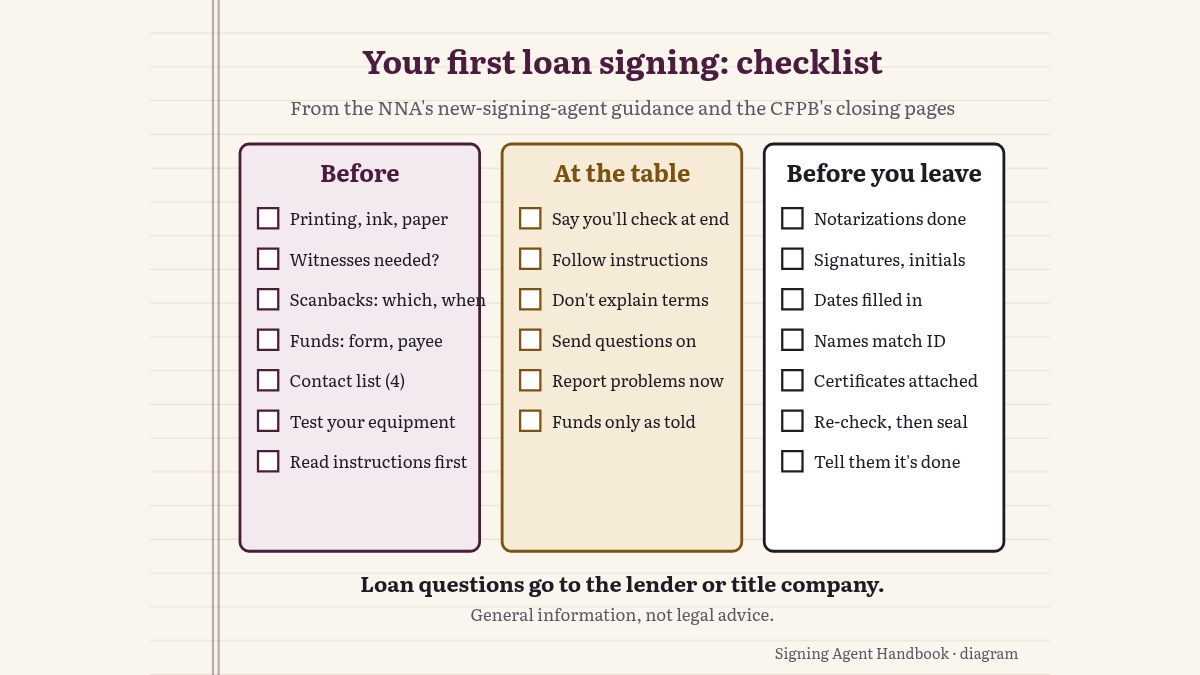
Do the work before you drive. Get the instructions, the signers’ names, the page and print details, a funds plan and a contact list. At the table, present the documents and get them signed and notarized, but don’t explain loan terms. The National Notary Association says that “as a Notary Signing Agent, you are not authorized to explain or provide any opinions on loan terms.” Before you leave, check every signature, initial, date and notarization, then check again once the package is sealed. This is a checklist built from the NNA’s and the CFPB’s published pages, and it isn’t a substitute for your assignment instructions or your state’s rules.
Disclosure: There are no affiliate links in this guide yet. If we add any later, we’ll say so right here. We aren’t paid to rank anything, and nothing here guarantees signing work or income. Our disclosure policy
Key facts
- Who explains the loan: not you. Send loan-term questions to the lender, loan officer or title/escrow company (NNA).
- What the borrower already has: a Closing Disclosure, which the lender must provide at least three business days before closing (CFPB).
- Main documents: the Closing Disclosure, the promissory note, the mortgage or deed of trust, and the deed (CFPB). Some documents, like the deed of trust, need a notarized signature.
- Before you leave: check notarizations, signatures and initials, and dates, and that names match the ID and the documents (NNA).
- When something goes wrong: report it to whoever hired you right away.
What’s actually happening at a closing?
The CFPB describes a mortgage closing like this: you “provide necessary funds to the settlement agent and sign legally binding documents in which you agree to pay back a loan and grant the lender the right to take back the house if you do not make your payments.” The settlement agent is often a title company, an escrow company in most western states, or a closing attorney in some eastern states (CFPB).
You’re usually not the settlement agent. You’re the notary who meets the borrower, runs the signing, and returns the package. A typical purchase closing includes these documents, according to the CFPB:
| Document | What the CFPB says it is |
|---|---|
| Closing Disclosure | A five-page form with the loan terms, projected monthly payments, and fees and other costs (closing costs) (CFPB). |
| Promissory note | “Your promise to repay the mortgage loan to your lender.” |
| Mortgage, or deed of trust | Also called the security instrument. The property is collateral, and the lender may foreclose if the loan isn’t repaid. |
| Deed | The document that transfers legal ownership of the property to the buyer. |
The CFPB adds: “For some of the documents you sign, like the deed of trust, your signature needs to be notarized.” Your assignment instructions say which documents need your notarization. Some loans, such as a reverse mortgage or a HELOC, don’t come with a Closing Disclosure, and the CFPB says those get different disclosures instead, so what’s in your package depends on the loan type.
Before the signing
1. Ask the questions the NNA says new agents forget. A March 2026 NNA Bulletin article by NNA Notary Ambassador Marcy Tiberio lists them (NNA Bulletin, Mar 2026):
- Any special printing instructions? Letter or legal size? Required ink color?
- Any witnesses required?
- Which pages need scanbacks, and by when?
- Will you collect funds from the borrower? If so, a personal check or certified funds, and payable to whom?
2. Build a contact list. The NNA lists four contacts: the signing service dispatcher or coordinator, an escrow or title company contact, the lender or loan officer (if provided), and an after-hours number.
3. Test your equipment before the real thing. The NNA’s advice is to test every piece of equipment, including a mixed letter-and-legal print and your scanning and uploading, so your first scanbacks aren’t from a live signing. Our supplies list covers what to have.
4. Print and read the package. Read the instructions first, then the package. Check that the documents you were told to expect are all there. If something is missing or unclear, such as a document the instructions mention that you can’t find, contact the hiring party before the appointment. The NNA says that for document-related questions, such as “a missing document page, an error that needs correction, or any printing issues,” you contact the hiring party.
At the table
5. Start with your quality-check promise. The NNA suggests telling the signers up front that you’ll do a quick review of the documents before the appointment ends, so the end check isn’t awkward.
6. Present the documents and get the signing done as the instructions say. Follow the instructions on which documents get signed, initialed and dated, and on any pages you are told not to date. Your state’s notary rules apply to every notarization, whatever the instructions say, so review them before the appointment. See our guides for Texas and Florida.
7. Don’t explain the loan. The NNA’s rule: “If the borrowers have questions about loan terms, fees, interest rates, or payment amounts, contact the lender, the loan officer or the title/escrow company, depending on the instructions provided to you.” The CFPB gives borrowers the same advice: “Let your lender or settlement agent know if you believe there are mistakes and ask about anything you don’t understand.” You’re the person who makes sure the signing is done right, not the person who explains the loan.
8. Report problems right away. The NNA says to tell the hiring party immediately, in a brief and professional message, if a signer is late, a name differs in the documents, a signer refuses to sign, or documents need reprinting.
9. Collect funds only as instructed. If your assignment includes collecting funds, you should already know the form of payment and the payee (step 1). The CFPB says the settlement agent is responsible for collecting the money and disbursing it, so if a request to collect funds is outside your instructions, call the hiring party.
Before you leave and after
10. Run your final check, in the same order every time. The NNA’s list:
- all notarizations are completed properly;
- all needed signatures and initials are on critical documents;
- dates are filled in where required;
- names match the signer’s ID and the documents, per your instructions;
- any separate notary certificates you were told to use are attached.
11. Check again after you package it. The NNA says to review the documents a second time before you seal the envelope, and to confirm the tracking number and delivery details.
12. Tell the hiring party it’s done. The NNA suggests a short message with the carrier, the time dropped off, any tracking number and the time scanbacks were sent.
Common slip-ups
- Explaining a fee or rate because the signer asked. Send the question to the lender, loan officer or title company.
- Leaving before checking. The NNA says new agents sometimes skip the check because they don’t want borrowers to think they did something wrong, or they’re eager to leave, and then discover missed signatures after leaving.
- Using your equipment for the first time at a live signing. Test the printer, scanner and upload before you accept.
- Not knowing who to call. Have the contact list before you leave home.
- Waiting to report a problem. Tell the hiring party right away.
First-signing questions
Can I answer a borrower’s questions about their loan?
Not about loan terms, according to the NNA. Refer them to the lender, loan officer or title/escrow company. The CFPB suggests the same for borrowers with questions about their closing documents.
What documents are in a loan signing package?
It depends on the loan. A typical purchase closing has a Closing Disclosure, a promissory note, a mortgage or deed of trust, and a deed, among others (CFPB). Your instructions list what you’re responsible for.
Does every loan come with a Closing Disclosure?
No. The CFPB says reverse mortgages, HELOCs, certain manufactured-housing loans and some homebuyer-assistance loans use other disclosures.
What if a document is missing or looks wrong?
Contact the hiring party before or during the appointment, as the NNA advises.
Is this advice for my state?
No. Notary rules differ by state. Check your state’s commissioning authority.
Where to go from here: Not commissioned yet? Start with how to become a loan signing agent. Building your kit? See the supplies list.
What this checklist is built from
This checklist draws on the NNA Bulletin article, two CFPB pages and one Notary Cafe thread, all opened October 30, 2026. The CFPB pages carry review dates of 2023 and 2024, so confirm them against your lender’s documents. We don’t copy the NNA’s comment section or name forum posters. We aren’t notaries, signing agents or attorneys, and this isn’t legal advice. We haven’t done a signing ourselves; this is a checklist built from published sources. Spotted a problem? Contact us.
Sources
- National Notary Association, “Common mistakes new Notary Signing Agents make (and how to fix them),” NNA Bulletin, March 2026: https://www.nationalnotary.org/notary-bulletin/blog/2026/03/common-mistakes-new-notary-signing-agents-make-and-how-to-fix-them
- Consumer Financial Protection Bureau, “I’m about to close on a real estate purchase transaction with a mortgage. What can I expect in the mortgage closing process?” (reviewed April 3, 2024): https://www.consumerfinance.gov/ask-cfpb/im-about-to-close-on-a-real-estate-purchase-transaction-with-a-mortgage-what-can-expect-in-the-mortgage-closing-process-en-1905/
- Consumer Financial Protection Bureau, “What is a Closing Disclosure?” (reviewed May 2, 2023): https://www.consumerfinance.gov/ask-cfpb/what-is-a-closing-disclosure-en-1983/
- Notary Cafe, “Questions for my first closing tommorrow” (Mar 2026): https://forum.notarycafe.com/t/questions-for-my-first-closing-tommorrow/55704
General information, not legal advice.