Short version
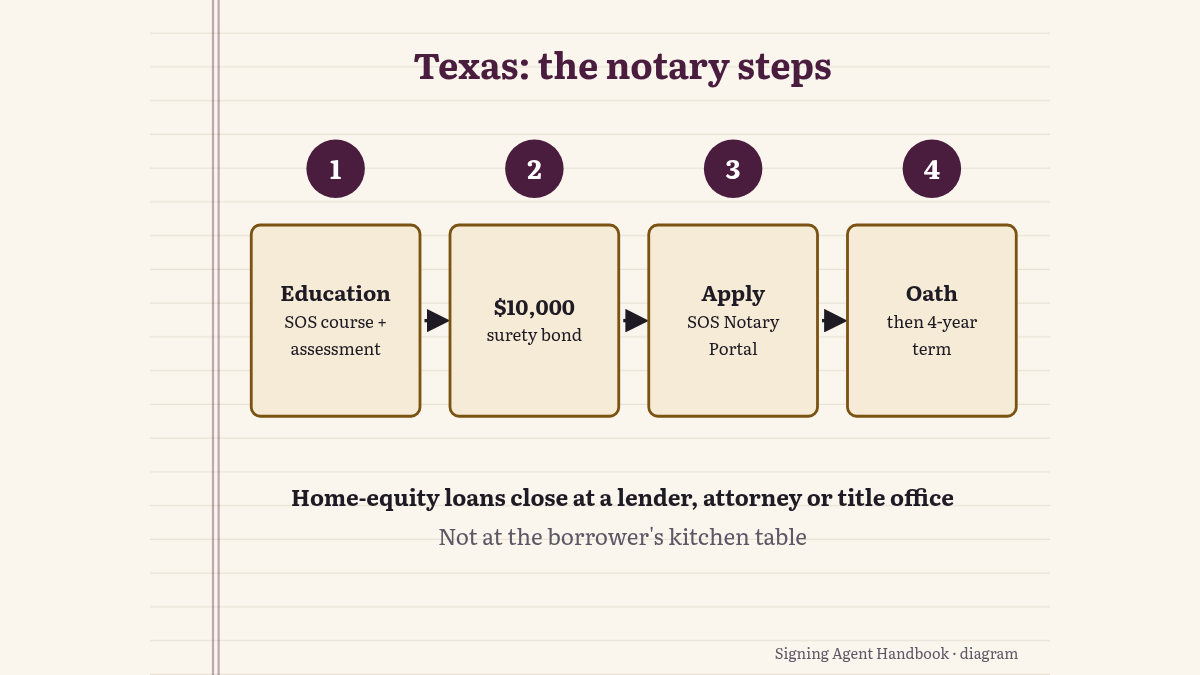
In Texas you become a notary public through the Secretary of State. Signing-agent work then builds on that commission. The SOS says plainly: “The Office does not commission or register signing agents” (TX SOS FAQ). The notary steps are: complete the SOS notary education requirement, get a $10,000 surety bond, apply through the SOS Notary Portal, and take the oath. One Texas-specific point for loan work: home-equity loans must close at the office of a lender, attorney or title company, not at the borrower’s kitchen table.
Disclosure: There are no affiliate links in this guide yet. If we add any later, we’ll say so right here. We aren’t paid to rank anything, and nothing here guarantees signing work or income. Our disclosure policy
Key facts
- Eligibility: Texas resident, 18+, no felony or crime of moral turpitude conviction. The SOS runs background checks.
- Education: the SOS course in the Notary Portal (videos plus a timed assessment), required for new and renewing notaries
- Bond: $10,000, from a surety company authorized in Texas
- Term: 4 years
- Record book: required
- Check with Texas if: you’re asked to do a home-equity (50(a)(6)) signing anywhere other than a lender, attorney or title company office
In Texas, the state part of loan signing is the notary commission. The rest (certification, screening, E&O) is set by the companies that hire you. Texas home-equity loans are where new agents most often slip. In January 2026 a Notary Cafe poster missed a wrong date on a recordable document in a 50(a)(6) cash-out refinance, and the title company’s compliance team was to overnight the document back so the signer could correct the date (thread). Below: the state steps in order, from the Texas Secretary of State’s pages and the statutes, including the $20 education course now required for new and renewing notaries.
Who can become a notary in Texas?
You must be a Texas resident, at least 18, and have no final conviction for a felony or a crime involving moral turpitude (Tex. Gov’t Code §406.004; TX SOS Notary Public page). The SOS says it “runs background checks on all notary applicants” and must reject an application or revoke a commission if it finds you’re not eligible.
What are the steps to become a Texas notary?
The SOS lists these steps for a traditional notary (TX SOS Notary Public page):
- Read the SOS Notary FAQs.
- Complete the Notary Education Requirement in the SOS Notary Portal. Per the SOS application guide, you pay a nonrefundable course fee of $20 (1 Tex. Admin. Code §87.5, adopted effective Jan. 1, 2026; Texas Register, Dec. 26, 2025, PDF), watch four videos all the way through, then pass an assessment you must finish within 30 minutes. The course must be completed within 90 days of payment. The requirement applies to new applicants and renewing notaries (TX SOS application guide, rev. 12/16/2025, PDF).
- Get a $10,000 surety bond from a solvent surety company authorized in Texas, payable to the governor (§406.010(a)). You upload the bonding company’s Proof of Bond (Form 2301-B) with your application.
- Submit the application through the SOS Notary Portal and pay the state fees. Tex. Gov’t Code §406.007 sets them: $10 for filing the bond, $1 for the SOS’s investigator and materials, and $10 for the commission, $21 in total (Tex. Gov’t Code §406.007). The bond itself is bought separately from the surety.
- Take the oath of office. It must be sworn before another notary or another person authorized to give oaths. You can’t administer your own (§406.010(d)).
The SOS notes it is updating the Texas Administrative Code under SB 693 to set out the education standards, so check the Notary Public page for changes before you start.
What does Texas require once you’re commissioned?
- Record book. “Yes. A Texas notary public is required to maintain a record book.” Required entries include the document date, the notarization date, each signer’s name and address, and how you identified them. If you use a credible witness, record that witness’s name and address (TX SOS FAQ). The SOS also says the record book is public information and belongs to you, not your employer.
- Seal on every notarial certificate (TX SOS FAQ).
- Fee limits. Tex. Gov’t Code §406.024 sets the maximum fees. For example, the statute lists $10 for the first signature on an acknowledgment and $1 for each additional signature. The SOS may adjust these for inflation every five years, so check the current figures with the SOS (§406.024). Many signing agents are paid a separate fee by signing services for the appointment. How notarial fees and signing fees relate is a question for your own attorney or the SOS. We don’t give legal advice on it. Whether one flat offer covers your own miles, printing and time is a separate, practical question: see our guide to weighing a $75 signing offer.
- Choosing certificates. The SOS says a notary “cannot select the type of notarial certificate used for any document unless they are also an attorney” (TX SOS FAQ). In loan packages, the certificates are already supplied.
- Advertising in another language. If you advertise notary services in a language other than English, the SOS FAQ lists notice requirements, and the phrase “notario publico” is prohibited.
What’s different about Texas home-equity signings?
This is the rule most likely to catch a new Texas signing agent. The Texas Constitution says a home-equity loan must be “closed only at the office of the lender, an attorney at law, or a title company” (Tex. Const. art. XVI, §50(a)(6)(N)). The Finance Commission’s rule adds that it must happen at that office’s permanent physical address. A power of attorney used for the closing must also be signed at such an office (7 Tex. Admin. Code §153.15).
What that means for you: if an assignment is a Texas home-equity (cash-out, 50(a)(6)) loan and the location is the borrower’s home, stop and ask the hiring company to confirm. Don’t decide it yourself. Texas law has added narrow exceptions for some borrowers (for example, certain military and disabled borrowers). Those are the lender’s call to apply.
Can you be a remote online notary (RON) in Texas?
Yes, as an add-on to a traditional commission. The SOS requires an X.509-compliant digital certificate and an electronic seal from a third-party company, plus the education requirement (TX SOS Notary Public page). The SOS FAQ says an online notary commission runs concurrently with your traditional commission.
What do Texas signing companies usually expect on top?
Not state requirements, but common asks: a signing-agent certification with a background screening, E&O insurance, and a printer that can handle large packages. For example, NNA’s $25,000 four-year E&O policy for Texas was $65 on October 22, 2026. See loan signing agent certification and notary E&O insurance vs. bond. The company screening is separate from anything the SOS checks, and the industry standard’s 2026 update lists Texas among 13 states that “limit reporting to 7 years” instead of the usual 10 (Signing Professionals Workgroup). More in signing agent background screening.
Who doesn’t need a course yet: anyone still working through the SOS steps above. The SOS “does not commission or register signing agents” (TX SOS FAQ), so no course is part of getting commissioned. Once you are, check what the two or three companies you’d apply to actually ask for before you pay for training.: “Compare course options”. Place only after the certification section has been read. Keep it to one link.
Common slip-ups
- Treating your bond as insurance. The SOS says E&O protects “the notary, and not the public.” The bond protects the public.
- Skipping record-book entries. Texas requires a record book with specific details (SOS FAQ).
- Doing a home-equity closing at the borrower’s home. Texas generally requires a lender, attorney or title company office (Tex. Const. art. XVI §50(a)(6)(N)).
- Assuming “certified” means “licensed.” The SOS doesn’t commission or register signing agents.
- Missing the 90-day education window after paying for the SOS course (SOS guide).
More Texas questions
Do I need a special license to be a loan signing agent in Texas?
No separate state license. The SOS says it doesn’t commission or register signing agents. You need a Texas notary commission.
How much is the Texas notary bond?
$10,000 (Tex. Gov’t Code §406.010).
How long is a Texas notary commission?
Four years (TX SOS FAQ).
Do Texas notaries have to keep a journal?
Yes, a record book with specific entries (TX SOS FAQ).
Is loan signing agent certification required in Texas?
Not by the state. Many hiring companies ask for one. See loan signing agent certification.
Where to go from here: Not commissioned yet? Start at the TX SOS Notary Public page. Commissioned? Read how to become a loan signing agent for the rest of the steps.
How we researched Texas
Researched specifically for Texas from the Texas Secretary of State’s own pages and Texas statutes, checked October 22, 2026. We aren’t notaries or attorneys, and this isn’t legal advice. Texas is changing its notary education rules under SB 693, so confirm current requirements with the Texas SOS. Spotted a problem? Contact us.
Sources
- Texas Secretary of State, Notary Public: https://www.sos.state.tx.us/statdoc/notary-public.shtml
- Texas SOS, Notary Public FAQs: https://www.sos.state.tx.us/statdoc/faqs2300.shtml
- Texas SOS, Submit/Renew a Traditional Notary Application (rev. 12/16/2025): https://www.sos.state.tx.us/statdoc/guides/TraditionalNotaryApplication.pdf
- Texas Government Code ch. 406 (§§406.004, 406.007, 406.010, 406.023, 406.024): https://statutes.capitol.texas.gov/Docs/GV/htm/GV.406.htm
- Texas Register, Dec. 26, 2025 (adopted 1 TAC §87.5, $20 course fee): https://www.sos.state.tx.us/texreg/pdf/backview/1226/1226adop.pdf
- Texas Constitution art. XVI §50: https://statutes.capitol.texas.gov/Docs/CN/htm/CN.16.htm
- 7 Tex. Admin. Code §153.15 (via LII; swap for official TAC link): https://www.law.cornell.edu/regulations/texas/7-Tex-Admin-Code-SS-153-15
- National Notary Association, E&O Insurance in Texas: https://www.nationalnotary.org/texas/insurance/errors-omissions
- About the National Notary Association: “The National Notary Association is the nation’s professional Notary organization and serves the professional, educational, career and business needs of Notaries throughout the U.S. Since 1957, the NNA has helped Notaries to serve society responsibly and ethically.” Linking policy: https://www.nationalnotary.org/support/linking-policy
- Reader threads quoted (public forums): https://forum.notarycafe.com/t/a6-cash-out-refi-in-texas-wrong-date/55038
General information, not legal advice.