In short
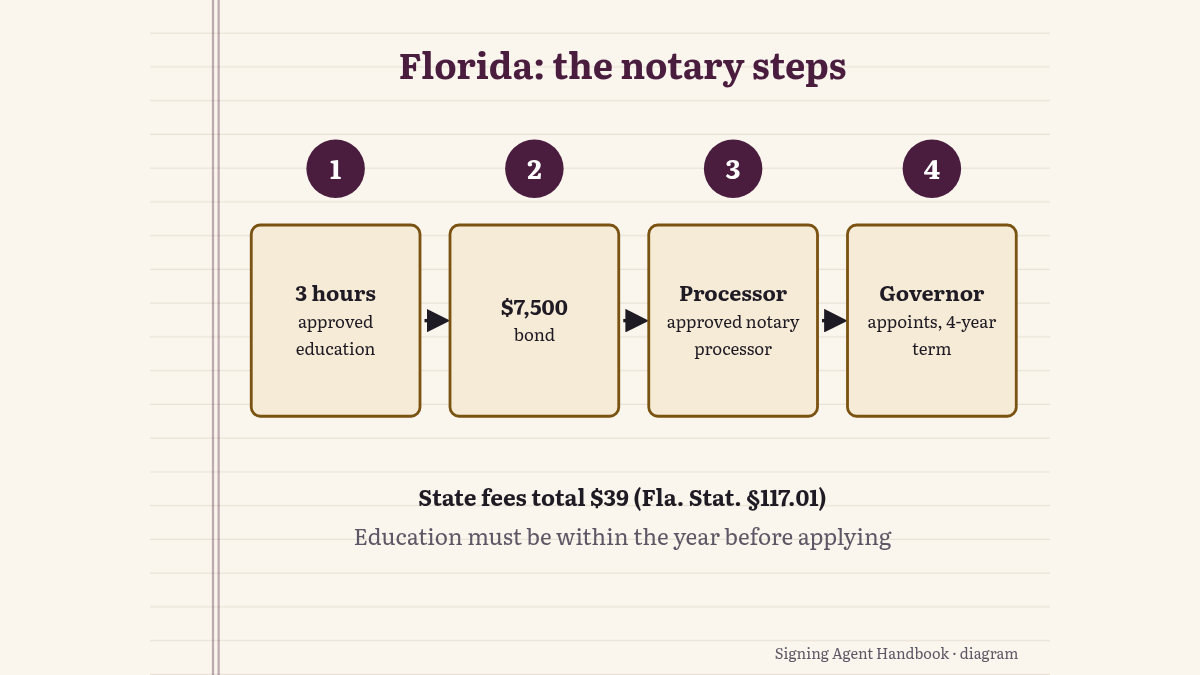
Florida notaries are appointed by the Governor for four-year terms, and applications go through an approved notary processor (typically a bonding agency) to the Department of State. First-time applicants need 3 hours of approved notary education taken within the year before applying, plus a $7,500 bond. The state fees total $39 under Florida Statutes §117.01. Signing-agent work then builds on that commission. Certification and E&O for traditional notaries are things companies expect, not things the state requires.
Disclosure: There are no affiliate links in this guide yet. If we add any later, we’ll say so right here. We aren’t paid to rank anything, and nothing here guarantees signing work or income. Our disclosure policy
In Florida, the first goal is the notary commission: 3 hours of approved education, a $7,500 bond and $39 in state fees. It pays to know exactly what the state requires before you buy extras. Florida posters on Notary Cafe report that companies “that use to start out offering $125” are offering less (Low Fees new normal, May 2026). Below: the Florida process from the statute and the state’s own notary pages, then what signing companies usually ask for on top.
Florida’s notary rules in one table
Each row comes from Florida’s statute or a state office page, linked in the last column. As of October 29, 2026, when we re-read each linked page.
| What | Florida’s rule | Official source |
|---|---|---|
| Who can apply | 18 or older, a legal Florida resident for the whole term, able to read, write and understand English | Fla. Stat. §117.01(1) |
| Education before applying | At least 3 hours of approved instruction, completed within 1 year before you apply (first-time applicants) | FL Dept. of State, Notary Education |
| Cost of the state’s own course | Free online | Executive Office of the Governor, Notary |
| State fees | $39: $25 application + $10 commission fee + $4 surcharge | Fla. Stat. §117.01(2) |
| Surety bond | $7,500, payable to anyone harmed by a breach of duty | Fla. Stat. §117.01(7)(a) |
| Term | 4 years | Fla. Stat. §117.01(1) |
| Renewal | No automatic reappointment: the full application every time | Fla. Stat. §117.01(6) |
| Where you may notarize | Only within Florida | Fla. Stat. §117.01(1) |
| Maximum fee per notarial act | $10 (marriages and online notarizations excepted) | Fla. Stat. §117.05(2)(a) |
| Online notary (RON) add-on | Separate registration; $25,000 bond and $25,000 E&O insurance | Fla. Stat. §117.225 |
Bond premiums, seals and course fees from private providers aren’t set by the state, so they aren’t in the table. The Governor’s Office says those are “competitively priced.”
Who can become a notary in Florida?
Under Fla. Stat. §117.01(1), you must be at least 18, a legal resident of Florida, and able to read, write and understand English. A permanent resident alien may apply with a recorded Declaration of Domicile. You must keep your Florida residence for the whole term, and you may act as a notary only “within the boundaries of this state” (Fla. Stat. ch. 117).
The application asks, among other things, whether you’ve been convicted of a felony (and if so, whether your civil rights were restored). It also requires an affidavit of good character from someone unrelated to you who has known you for at least a year (§117.01(2)).
What are the steps to become a Florida notary?
- Take the 3-hour course. “A first time applicant for a notary commission must submit proof that the applicant has, within one year prior to the application, completed at least three hours of interactive or classroom instruction, including electronic notarization, and covering the duties of the notary public” (FL DOS Notary Education). The Department of State offers a course with the Governor’s Office. Other approved providers are listed by the Executive Office of the Governor. The Governor’s Office says the Department of State’s course “can be taken online, free of charge” (EOG, Notary).
- Choose an approved notary processor. The Department of State says “all notary commission applications and notary name changes must be submitted through an approved notary processor” (FL DOS Notary Forms). The application packet includes the Notary Public Application (DS-DE 77) and the Bond of Notary Public (DS-DE 76).
- Get the $7,500 bond. It’s payable “to any individual harmed as a result of a breach of duty by the notary public acting in his or her official capacity” and must come from an authorized surety company (§117.01(7)(a)).
- Pay the state fees and swear the oath. $25 application fee + $10 commission fee + $4 surcharge (§117.01(2)). As part of the oath, you swear that you’ve read chapter 117 and know a notary’s duties and limits (§117.01(3)). In Florida you apply through a bonding agency, which typically bundles the state fees, the bond and a seal into one payment. The Governor’s Office says “the state fees of $39 are fixed by law, but the bond premium and the notary seal are competitively priced” and recommends checking several companies (EOG, Notary).
Fee waiver: §117.01(2) waives the commission fee for certain wartime veterans with a VA disability rating of 50% or more, subject to verification by the Secretary of State.
What rules apply once you’re commissioned?
- Fee cap. “The fee of a notary public may not exceed $10 for any one notarial act,” except for marriages and online notarizations (§117.05(2)(a)). How that interacts with the appointment fee a signing service pays you is a question for the Department of State or your own attorney. We don’t give legal advice on it. Whether a given offer covers your own costs is a practical question: see our guide to weighing a $75 signing offer.
- ID. You may not notarize a signature unless you personally know the signer or have “satisfactory evidence” of identity. The certificate must say which type of ID you relied on (§117.05(5)).
- Certificate contents include whether the signer appeared by physical presence or by online notarization, the date, the signer’s name, the ID type, your signature, your typed/printed/stamped name and your official seal (§117.05(4)).
- Prohibited acts include signing with a name other than your commissioned name, pre-signing blank certificates, and notarizing for someone who appears unable to understand the document (§117.107).
- Changes. Notify the Department of State in writing within 60 days of changing your business or home address, phone numbers or criminal record (§117.01(2)).
- Journal. Chapter 117 sets an electronic journal requirement for online notarizations (§117.245). We didn’t find a journal requirement for traditional paper notarizations in chapter 117, and the Governor’s Reference Manual says a journal is “not required by Florida law” but recommends considering one “to provide a permanent record” (Governor’s Reference Manual, Dec. 17, 2019, PDF). Many signing companies expect a journal regardless.
- Foreign-language ads. Non-attorney notaries who advertise in a language other than English must include a specific English notice (§117.05(10)).
Can you add remote online notarization (RON) in Florida?
Yes, as a separate registration with the Department of State. Under §117.225 you need a current commission, a completed classroom or online RON course, a registration fee, a named RON service provider, a $25,000 bond, and $25,000 of E&O insurance. That makes Florida one of the places where E&O is legally required, but only for online notaries.
Rule change under way (2026): the Department of State held a public workshop on August 14, 2026 on amendments to Rule 1N-7.001, F.A.C. The amendments would “adopt standards for the use of biometric verification as a means of identity proofing in the remote online notarization process” (FL DOS workshop agenda). Check the current rule with the Department of State before you register.
What do Florida signing companies usually expect on top?
Common asks that aren’t state law for traditional notaries: a signing-agent certification with a background screening, E&O insurance and a capable printer. For example, NNA’s $25,000 four-year E&O policy for Florida was $65 on October 22, 2026. See loan signing agent certification and notary E&O insurance vs. bond. The company screening is a separate check from the state’s appointment process; what it searches and how it’s scored are in signing agent background screening.
Who doesn’t need a course yet: anyone still on the state steps above. Florida’s required education is the 3 hours of approved instruction for first-time applicants in the table above, and a private signing-agent course isn’t part of it. Once you’re commissioned, check what the companies you’d apply to actually ask for before you pay for training.: “Compare course options”. One link maximum, after the certification mention.
Common slip-ups
- Taking the course too early. It has to be completed within one year before you apply (FL DOS).
- Expecting automatic renewal. Florida has none. You complete the full application every time (§117.01(6)).
- Charging more than the cap for a notarial act. $10 per act, with exceptions (§117.05(2)(a)).
- Notarizing outside Florida. Your commission only works within the state (§117.01(1)).
- Starting RON without the extra bond and E&O. Online notaries need both at $25,000 (§117.225).
More Florida questions
Do I need a license to be a loan signing agent in Florida?
We found no separate signing-agent license in chapter 117. You need a Florida notary commission. Hiring companies then set their own requirements.
How much does it cost to become a notary in Florida?
State fees are $39 ($25 + $10 + $4, §117.01(2)). On top of that come the bond premium and seal, which bonding agencies price competitively (EOG), and a course fee if you don’t use the Department of State’s free course. The total depends on the bonding agency you choose.
How long is a Florida notary commission?
Four years (§117.01(1)).
Is the 3-hour course required for renewals?
The education requirement quoted by the Department of State applies to first-time applicants. Every reappointment still needs a full application (§117.01(6)).
Do I need E&O insurance in Florida?
Not for a traditional commission under chapter 117. It is required (at least $25,000) to register as an online notary (§117.225(7)). Signing companies often ask for it regardless.
Where to go from here: Not commissioned yet? Start with FL DOS Notary Education. Commissioned? Read how to become a loan signing agent for the rest of the steps.
How we researched Florida
Researched specifically for Florida from Florida Statutes chapter 117 (2026 edition), the Florida Department of State’s notary pages and the Governor’s notary education page, checked October 22, 2026. The figures in the requirements table were re-checked against the linked pages on October 29, 2026. We aren’t notaries or attorneys, and this isn’t legal advice. Confirm current requirements with the Florida Department of State. Spotted a problem? Contact us.
Sources
- Florida Statutes ch. 117, Notaries Public (2026): https://www.flsenate.gov/Laws/Statutes/2026/Chapter117/All
- Florida Department of State, Notary Education Program: https://notaries.dos.fl.gov/education/
- Florida Department of State, Downloading Notary Forms: https://dos.fl.gov/sunbiz/other-services/notaries/notary-forms
- Executive Office of the Governor, Notary Education: https://www.flgov.com/eog/info/notary/education
- Executive Office of the Governor, Notary (free DOS course; $39 state fees; bonding agencies): https://flgov.com/eog/info/notary
- Executive Office of the Governor, Governor’s Reference Manual for Notaries Public (Dec. 17, 2019): https://www.flgov.com/eog/sites/default/files/notary/Governors_Notary_Reference_Manual_12-17-19.pdf
- National Notary Association, E&O Insurance in Florida: https://www.nationalnotary.org/florida/insurance/errors-omissions
- About the National Notary Association: “The National Notary Association is the nation’s professional Notary organization and serves the professional, educational, career and business needs of Notaries throughout the U.S. Since 1957, the NNA has helped Notaries to serve society responsibly and ethically.” Linking policy: https://www.nationalnotary.org/support/linking-policy
- Florida Department of State, Rule 1N-7.001 workshop agenda (Aug 14, 2026): https://files.floridados.gov/media/711296/rule-workshop-agenda-1n-7001.pdf
- Reader threads quoted (public forums): https://forum.notarycafe.com/t/low-fees-new-normal/56229
General information, not legal advice.