In short
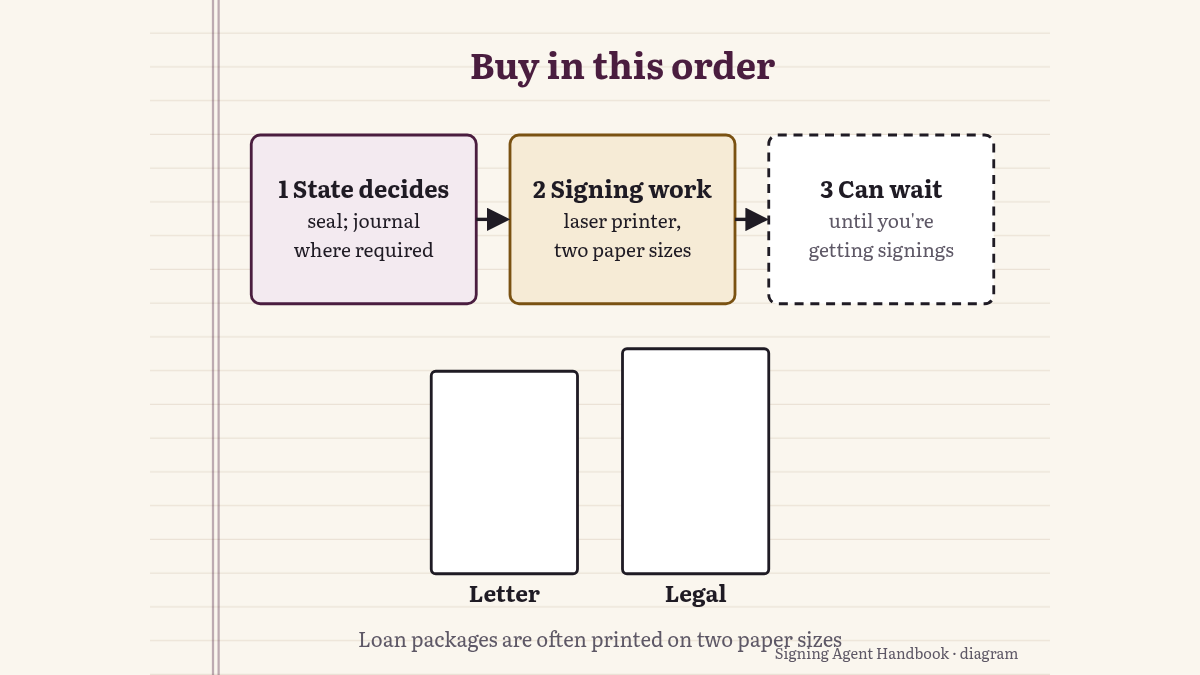
Your state decides your notary tools: the seal, whether a journal is required, and what goes in it. Signing work adds business tools. The one new agents ask about most is the printer, because loan packages run long and can mix letter and legal pages. Buy the state-required items first, then a printer that handles both paper sizes. Everything else can wait until you’re getting signings.
Disclosure: There are no affiliate links in this guide yet. If we add any later, we’ll say so right here. We aren’t paid to rank anything, and nothing here guarantees signing work or income. Our disclosure policy
Key facts
- State-required (varies): official seal; a journal/record book where required (Texas requires one; see below)
- For signing work: a printer that handles letter and legal paper, paper in both sizes, pens, an ID check routine
- Can wait: branded extras, mobile printers, scanners
- Check with your state if: you’re unsure what your seal and journal must contain
New agents ask about paper more than anything else on this list. The most-replied printing thread we found on Notary Cafe this year was “What kind of Paper is everyone using?” (Jan 2026, 58 posts), and it started with cost: “I used to use nice paper but it’s starting to cost me too much!” (thread). Another new agent, holding a first refi package of 89 letter pages and 2 legal pages, couldn’t tell which two pages were legal size (thread, Feb 2026). Every item below goes into one of three groups: required by your state, needed for loan signings, or nice to have later. Skip the “starter bundle.”
What does your state require?
These come from your commissioning authority. Don’t take a vendor’s word for it.
| Item | Texas (example) | Florida (example) |
|---|---|---|
| Seal | Required; the notarial certificate must include the notary’s seal (TX SOS FAQ) | Official seal required on notarizations (Fla. Stat. §117.05, ch. 117) |
| Journal / record book | Required. Contents include document date, notarization date, signer name and address, ID method and more (TX SOS FAQ) | Chapter 117 requires an electronic journal for online notarizations (§117.245). For traditional notarizations, the Governor’s Reference Manual says a journal is “not required by Florida law” but suggests keeping one as protection (Governor’s Reference Manual, Dec. 17, 2019, PDF) |
Other states differ. Use your state page: becoming a loan signing agent in Texas · becoming a loan signing agent in Florida.
What do you need for loan signings specifically?
| Item | Why | Cost |
|---|---|---|
| Printer that can handle letter and legal paper | Loan packages are long and can mix paper sizes (see the reader threads above) | Varies widely by model and seller; compare current prices and the cost per page of toner |
| Letter and legal paper | Some packages need legal-size pages | Varies by seller; buy both sizes |
| Toner (spare) | Running out mid-print delays a signing | Varies by printer model |
| Pens | Follow each package’s own instructions on ink | Low; any office supplier |
| E&O insurance | Commonly expected by companies (see notary E&O insurance vs. bond) | Example: on October 27, 2026 NNA listed its $25,000 / 4-year policy at $65 in Texas and in Florida. Prices differ by state. |
| Folder/envelope system | Keeps packages and return labels organized | Low; any office supplier |
Choosing a printer
We don’t recommend a model here. We haven’t tested any, and nothing in this guide is paid placement. What the reader threads above point to is a short list of things to check on any printer’s spec sheet before you buy:
- Paper sizes: can it take letter and legal? One reader’s package had 89 letter pages and 2 legal pages. Replies in that thread suggested printing the legal pages separately, from a bypass or manual-feed slot or by choosing paper by size. So a second tray is convenient, and a bypass slot may be enough.
- Duplex: some loan packages specify single-sided printing, so read the instructions before you print.
- Running cost: loan packages are long. Compare the cost per page of toner or ink, not only the sticker price. That per-page cost is one of the lines to add up before accepting a job; our guide to weighing a $75 signing offer walks through the rest.
What can wait?
Mobile printers, portable scanners, branded stationery and paid directory listings can all wait until you’re getting regular work and know what you actually need. What to pack and check on the day itself is in your first loan signing, step by step.
A fax line is the same kind of question. A new agent asked Notary Cafe in May 2026 whether to pay for one before taking any jobs, since it means “a monthly cost of at least $10, no matter if I’m making money or not” (thread). Check whether the listing or company that asks for a fax number will take email or upload instead before you subscribe.
Common slip-ups
- Buying a journal that doesn’t fit your state’s rules. Texas lists specific record-book contents (TX SOS FAQ).
- Assuming your seal vendor knows your law. Check your state’s own page.
- Buying a printer on sticker price alone. Loan packages run long. Check print speed, legal-size paper handling and the running cost per page before you buy.
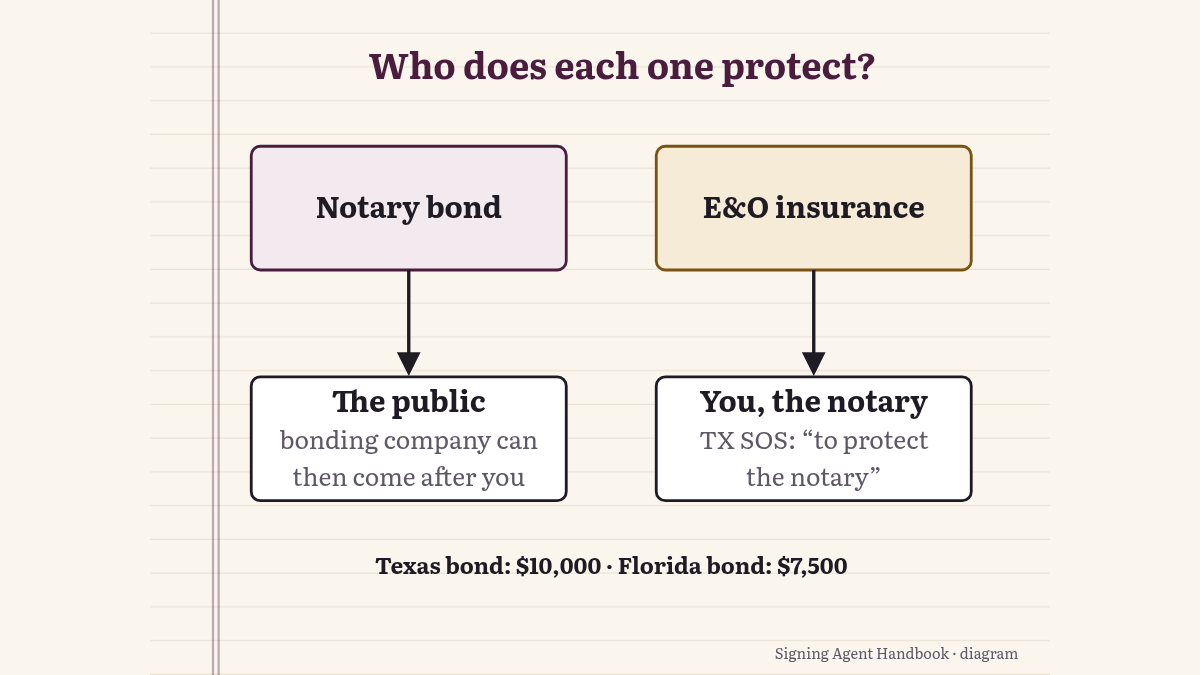
- Buying E&O as if it were your bond. They’re different (TX SOS FAQ).
Supply questions, briefly
What do you need to become a loan signing agent?
A notary commission first, then the items above. See how to become a loan signing agent.
Do I need a dual-tray printer?
No law we found requires one. Packages can mix letter and legal pages, and readers in the threads above got by with a bypass slot or by printing the legal pages separately.
Is a notary journal required?
It depends on your state. Texas requires a record book. Florida’s statute sets journal rules for online notarizations, and the Governor’s manual says a journal isn’t required for traditional ones but is worth keeping. Check yours.
Where to go from here: Sort out insurance next: notary E&O insurance vs. bond.
How we checked this page
Built from the sources below, checked October 27, 2026. We haven’t hands-on tested any equipment. The one price we quote, NNA’s E&O policy, is from NNA’s own pages on October 27, 2026. Where we give no price, it varies too much by model and seller to quote. We aren’t notaries or attorneys, and this isn’t legal advice. Spotted a problem? Contact us.
Sources
- Texas SOS, Notary Public FAQs: https://www.sos.state.tx.us/statdoc/faqs2300.shtml
- Florida Statutes ch. 117 (2026): https://www.flsenate.gov/Laws/Statutes/2026/Chapter117/All
- National Notary Association, Errors and Omissions Insurance in Texas: https://www.nationalnotary.org/texas/insurance/errors-omissions
- National Notary Association, Errors and Omissions Insurance in Florida: https://www.nationalnotary.org/florida/insurance/errors-omissions
- Florida Executive Office of the Governor, Governor’s Reference Manual for Notaries Public (Dec. 17, 2019): https://www.flgov.com/eog/sites/default/files/notary/Governors_Notary_Reference_Manual_12-17-19.pdf
- About the National Notary Association: “The National Notary Association is the nation’s professional Notary organization and serves the professional, educational, career and business needs of Notaries throughout the U.S. Since 1957, the NNA has helped Notaries to serve society responsibly and ethically.” Linking policy: https://www.nationalnotary.org/support/linking-policy
- Reader threads quoted (public forums): https://forum.notarycafe.com/t/what-kind-of-paper-is-everyone-using/54963 · https://forum.notarycafe.com/t/new-notary-question-letter-or-legal-size/55409 · https://forum.notarycafe.com/t/what-fax-service-do-you-recommend-to-a-new-nsa/56463
General information, not legal advice.