The quick answer
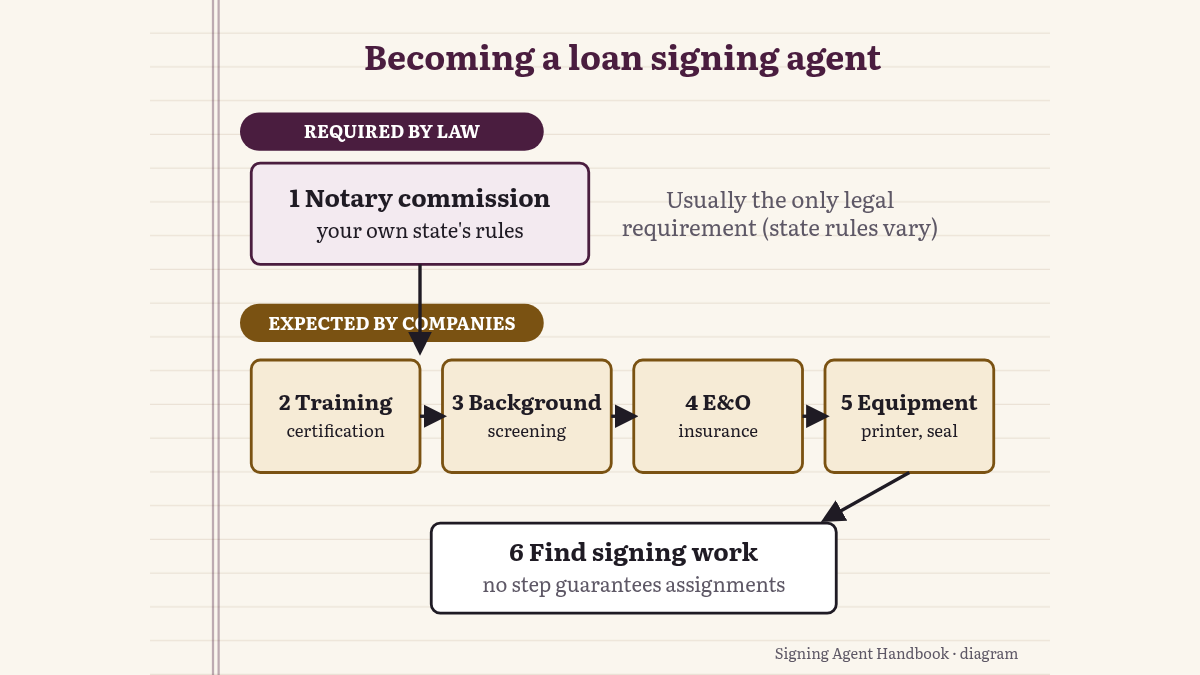
A loan signing agent is a commissioned notary public who takes borrowers through a loan package and notarizes the signatures that need it. The only legal requirement in most places is the notary commission itself. In Texas, for example, the Secretary of State says it “does not commission or register signing agents” (Texas SOS FAQ). Certification, background screening and E&O insurance are things signing companies usually expect, not things the state requires.
Disclosure: There are no affiliate links in this guide yet. If we add any later, we’ll say so right here. We aren’t paid to rank anything, and nothing here guarantees signing work or income. Our disclosure policy
Key facts
- Step one everywhere: become a notary under your own state’s rules.
- Required by law: your state’s notary commission requirements (they vary a lot).
- Usually expected by companies: a background screening, a signing-agent certification, E&O insurance and the right equipment.
- Check with your state if: your state limits who can conduct real estate closings. Some states involve attorneys. Read your state’s page before you spend money.
The law usually asks for one thing: a notary commission. Signing companies ask for more: a certification, a background screening, E&O insurance, and a printer that handles legal-size paper. That second list is where new agents spend money before they need to. The steps below are in order, with what the law requires kept apart from what hiring companies expect.
One thing the forums make clear: finishing the steps doesn’t guarantee work. In September 2026 a Notary Cafe poster wrote that after a year and a half on six listing sites, “I have only completed 3 signings” (No signings).
What does a loan signing agent actually do?
A loan signing agent (also called a notary signing agent, or NSA) is a notary hired to meet a borrower, present the loan documents, get them signed and notarized correctly, and return them on time. The NNA describes the role as a notary trained to handle loan document signings (National Notary Association).
The line you can’t cross: a signing agent who isn’t an attorney can’t explain loan terms or give legal advice. If a borrower asks “should I sign this?” or “what does this rate mean?”, the answer is to contact their lender or an attorney.
Step 1: Become a notary public in your state
Every signing agent starts as a commissioned notary, and each state sets its own rules. Two examples show how much they differ:
| Texas | Florida | |
|---|---|---|
| Who commissions | Secretary of State | Governor (applications through the Department of State) |
| Education | SOS notary education course and assessment before you apply or renew (TX SOS application guide, PDF) | 3 hours of approved instruction for first-time applicants (FL DOS Notary Education) |
| Bond | $10,000 (Tex. Gov’t Code §406.010) | $7,500 (Fla. Stat. §117.01(7)) |
| Term | 4 years (TX SOS FAQ) | 4 years (Fla. Stat. §117.01(1)) |
Our state pages go through each state’s process using its own official sources: becoming a loan signing agent in Texas and becoming a loan signing agent in Florida. More are coming at signing agent requirements by state.
Step 2: Learn loan documents (training or certification)
Is it legally required? Generally no. In Texas, for example, the state doesn’t register signing agents at all (TX SOS FAQ above). Is it expected? Often, yes. Many signing services and title companies ask for a certification.
Common options, with prices from each provider’s own page on October 22, 2026:
- NNA Certification: $199. Includes training, an exam (80% to pass), a background screening and a listing on SigningAgent.com. You need an active notary commission first (National Notary Association). The exam format, the yearly renewal and what the $199 leaves out are in our NNA signing agent certification guide.
- Notary2Pro Elite course: $300 one-time (Notary2Pro). Its own page says training “does not guarantee income, signing assignments or business results.”
- Loan Signing System course: $347, or 4 payments of $97. Includes video training on five loan signing types, mock signings, 4 months of live mentorship with biweekly group coaching calls, and the LSS certification. Its refund window is 30 days, and only if you haven’t yet received the LSS certification (Loan Signing System). Its refund, mentorship and arbitration terms are covered in the Loan Signing System review.
Hold off on any course if you aren’t commissioned yet (the NNA requires an active commission before its certification), or if the signing services you plan to apply to haven’t told you which credential they want. Step 2 is about what companies expect, not what the law requires, so their onboarding pages are the better guide than any ad.
The full breakdown is in loan signing agent certification.
Step 3: Pass a background screening
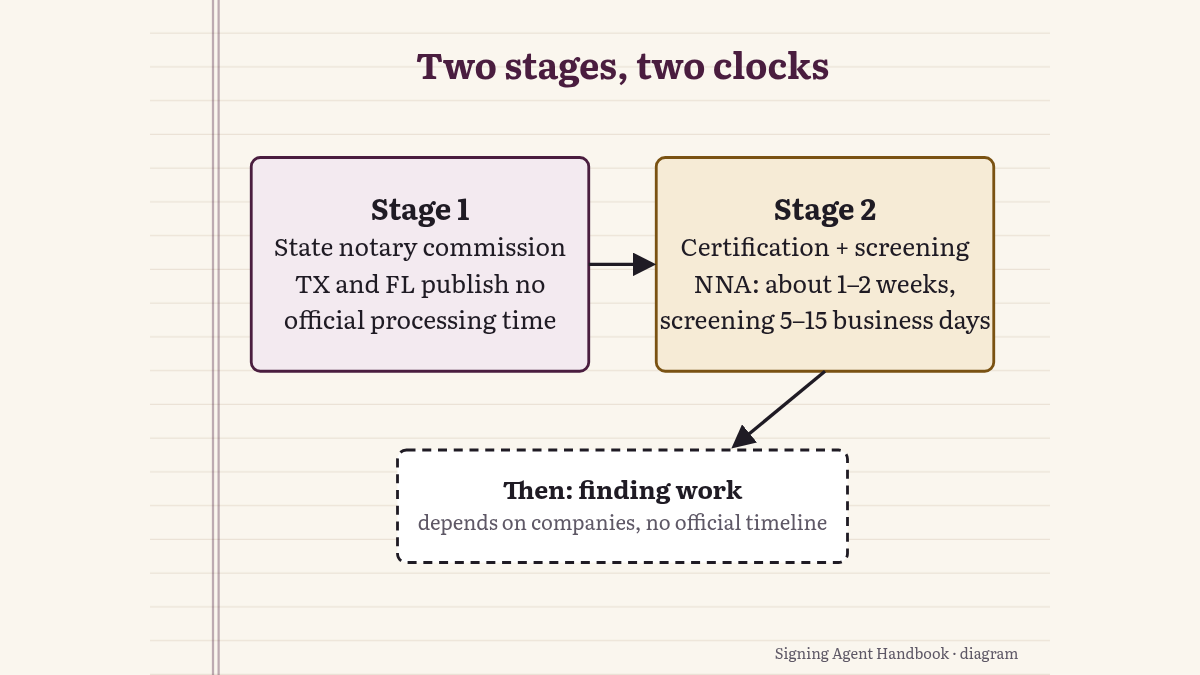
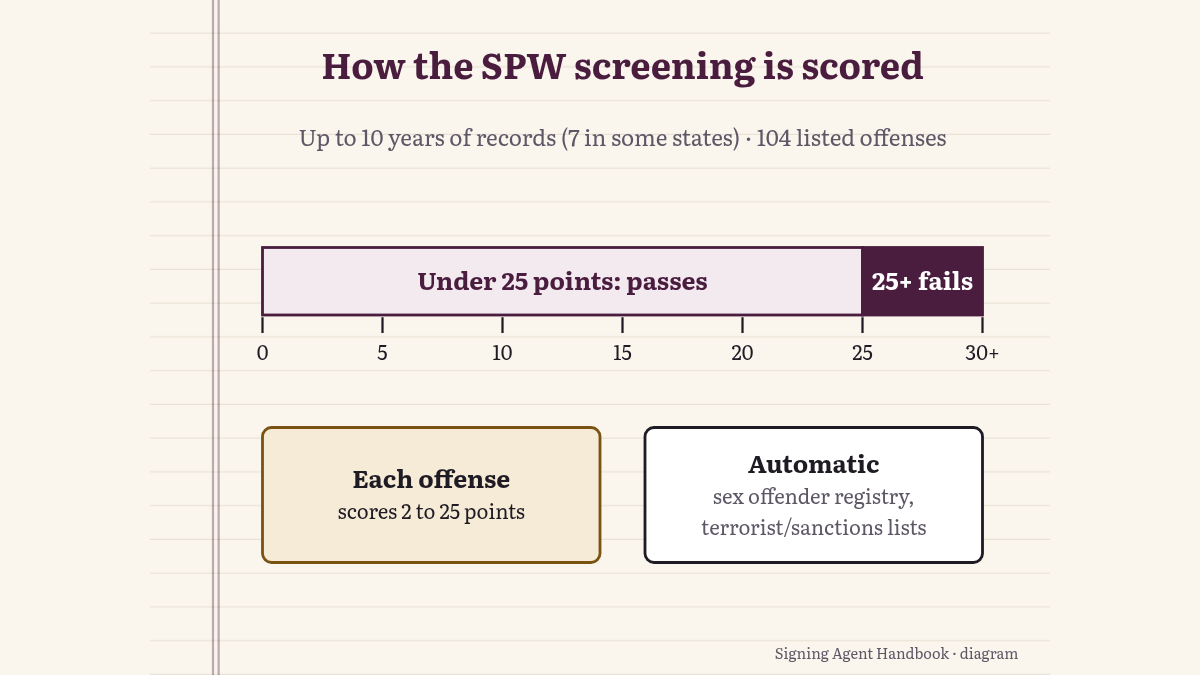
Many companies want a recent background screening before they’ll send you work. NNA certification bundles one through Backgrounds Online, which the NNA says takes about 5-15 business days (National Notary Association). Separately, your state may run its own check as part of the notary application. Texas does. What the industry screening searches, how offenses are scored and how to dispute a wrong report are in signing agent background screening.
Step 4: Get E&O insurance (and know it isn’t your bond)
Your notary bond protects the public, not you. Errors and omissions (E&O) insurance protects you. The Texas SOS says so directly: E&O policies “are additional insurance purchased by the notary to protect the notary, and not the public” (TX SOS FAQ). Signing companies commonly ask for E&O coverage. Details and price examples are in notary E&O insurance vs. bond.
Step 5: Get the equipment
You’ll need to print large loan packages, often on two paper sizes, plus the notary tools your state requires (seal, and a journal where required). See our loan signing agent supplies list.
Step 6: Find signing work
New signing agents usually start with signing services (companies that hire notaries for title companies and lenders) and later work directly with title and escrow companies.
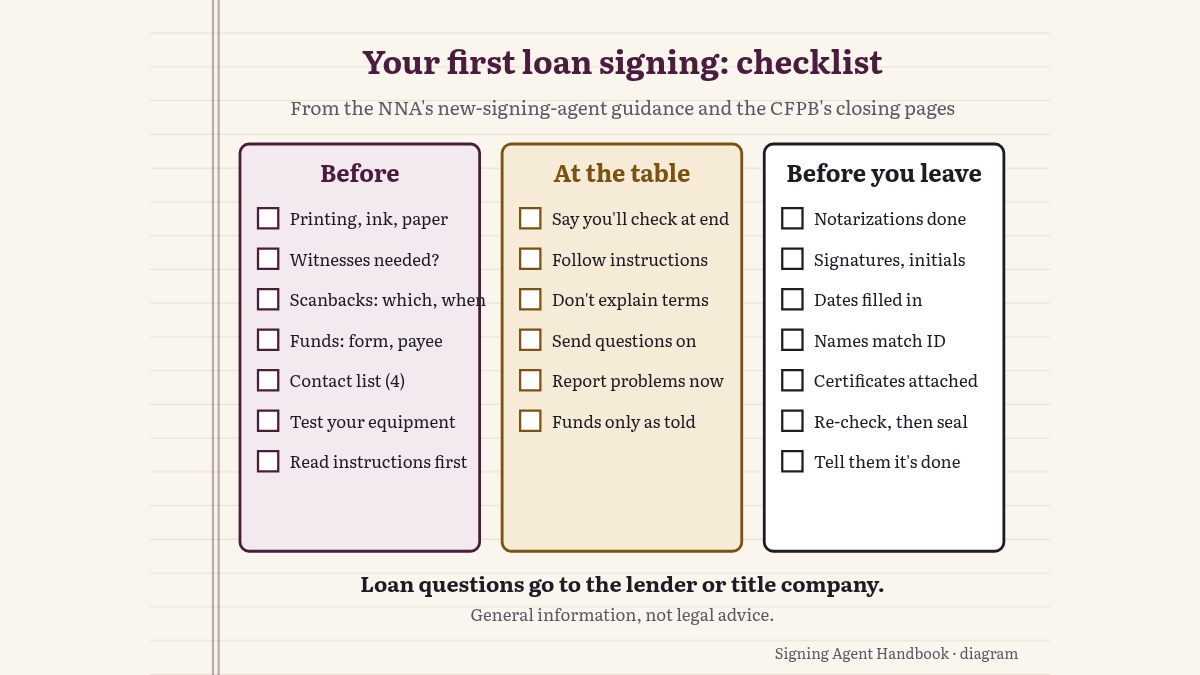
Be realistic: how much work you get depends on your area, loan volume and how fast you respond. No course, certification or listing can promise assignments. For the paperwork side of the wait, see how long it takes to become a loan signing agent; for the day the first job comes, use your first loan signing, step by step.
Two habits that save new agents trouble:
- Ask for the page count before you accept. One Notary Cafe poster took a HELOC that was expected to be short and found it “turned out to be 105 pages” (thread, Dec 2025). To turn the page count and the miles into a yes or no, see our guide to weighing a $75 signing offer.
- Check unexpected requests before you reply. The National Notary Association’s July 2026 bulletin describes email, text and social-media scams aimed at notaries, including spoofed emails that look like they come from a real company and scammers posing as a title company to send altered wiring instructions (National Notary Association).
Common slip-ups
- Paying for certification before you’re commissioned. NNA certification requires an active commission first (NNA).
- Treating your bond as your insurance. The bond protects the public. E&O protects you (TX SOS FAQ).
- Explaining loan terms to borrowers. That’s legal or financial advice. Send them to their lender or an attorney.
- Assuming one state’s rules apply in another. Bond amounts, education and journal rules differ, as the table above shows.
Questions readers ask
Do I need a license to be a loan signing agent?
In many states there’s no separate signing-agent license; you need a notary commission. Texas’s SOS, for example, says it doesn’t commission or register signing agents. Check your own state’s commissioning authority.
How much does it cost to become a loan signing agent?
It depends on your state’s notary costs plus the optional extras you choose (certification, screening, E&O, equipment). See the price examples above and on each state page. We don’t use one national “total” because it would be wrong for most states.
Can I do loan signings in any state?
Your commission lets you notarize only within your commissioning state. Florida’s statute, for example, says a notary may act only “within the boundaries of this state” (Fla. Stat. §117.01(1)).
Is certification the same as a notary commission?
No. Notary2Pro’s own FAQ says its certification “does not replace any state-required Notary commission.”
Where to go from here: Not a notary yet? Start with your state page. Already commissioned? Read loan signing agent certification next.
How we checked this page
This guide is built on the official and provider sources below, cited inline and checked October 22, 2026. We aren’t notaries, signing agents or attorneys, and this isn’t legal advice. Rules change, so confirm with your state’s commissioning authority. Spotted a problem? Contact us.
Sources
- Texas Secretary of State, Notary Public FAQs: https://www.sos.state.tx.us/statdoc/faqs2300.shtml
- Texas SOS, Traditional Notary Application guide (rev. 12/16/2025): https://www.sos.state.tx.us/statdoc/guides/TraditionalNotaryApplication.pdf
- Texas Government Code ch. 406: https://statutes.capitol.texas.gov/Docs/GV/htm/GV.406.htm
- Florida Statutes ch. 117 (2026): https://www.flsenate.gov/Laws/Statutes/2026/Chapter117/All
- Florida Department of State, Notary Education: https://notaries.dos.fl.gov/education/
- National Notary Association, Notary Signing Agent Training: https://www.nationalnotary.org/notary-signing-agent-training
- Notary2Pro, Loan Signing Agent Training: https://notary2pro.com/loan-signing-agent-training/
- Loan Signing System, course pricing: https://www.loansigningsystem.com/coursepricing.html
- National Notary Association, Notary Bulletin (Jul 2026), scams targeting notaries: https://www.nationalnotary.org/notary-bulletin/blog/2026/07/dont-take-the-bait-the-email-text-and-social-media-scams-targeting-notaries-right-now
- Reader threads quoted (Notary Cafe, public): https://forum.notarycafe.com/t/no-signings/58036 · https://forum.notarycafe.com/t/is-there-any-way-to-know-the-page-count-before-accepting-a-signing/54795
- About the National Notary Association: “The National Notary Association is the nation’s professional Notary organization and serves the professional, educational, career and business needs of Notaries throughout the U.S. Since 1957, the NNA has helped Notaries to serve society responsibly and ethically.” Linking policy: https://www.nationalnotary.org/support/linking-policy
General information, not legal advice.